Two layers of bitumen membrane — base sheet and cap sheet — with flashings at parapet walls, outlets and chimneys. If the roof needs it, with insulation in bitumen-faced EPS boards or PIR boards.
A typical build-up when the covering is replaced and insulation added. Without insulation, the base sheet goes straight onto the primed substrate.
01/ 06
Cap sheet
The top layer, with mineral granules — it takes the sun, rain and frost.
What we watch out for
Laps torched across their full width, with an even bead of bitumen at the edge.
01/ 06
Cap sheet
The top layer, with mineral granules — it takes the sun, rain and frost.
What we watch out for
Laps torched across their full width, with an even bead of bitumen at the edge.
Technologies
Torch-on bitumen membrane
Base sheet and cap sheet, torched down into a two-layer bitumen system.
When
For a new covering, or for replacing old bitumen roofing on a roof prepared for a bitumen system.
Key points
A continuous bead of bitumen at the laps, staggered seams between layers and careful upstands at details.
Roofing work
Flashings and terminations of the covering at parapet walls, outlets, chimneys and roof edges.
When
Wherever the covering changes plane: parapet walls, eaves, outlets, chimneys and service penetrations.
Key points
An angle fillet in the corner, upstands onto vertical elements, and a parapet coping that falls towards the roof.
Roof insulation
Bitumen-faced EPS boards or PIR boards under a new bitumen covering.
When
When replacing the covering or when the roof does not meet current thermal requirements.
Key points
Vapour control layer, board facing compatible with bitumen membrane, and outlets raised to the new roof thickness.
A watertight roof starts with the substrate
A bitumen covering must form one continuous system with the drains, parapet walls and penetrations. Before we start, we plan the layers and every place where the covering changes plane.
Substrate
We check that the surface is load-bearing, even and prepared for a bitumen covering.
Laps
We take care over the joints between successive strips and the continuity of the membrane layers.
Parapet walls and edges
We tie the upstands and flashings into the main roof covering.
Outlets and penetrations
Every drain and service element gets a watertight connection to the bitumen membrane.
We check
We assess the condition and preparation of the substrate
We check the falls and drainage
We plan watertight joints and terminations
We use compatible components from a single system
We avoid
We don’t trap moisture in unstable layers
We don’t skip thresholds, edges and drains
We don’t mix incompatible materials at random
We don’t treat the surface alone as the whole waterproofing
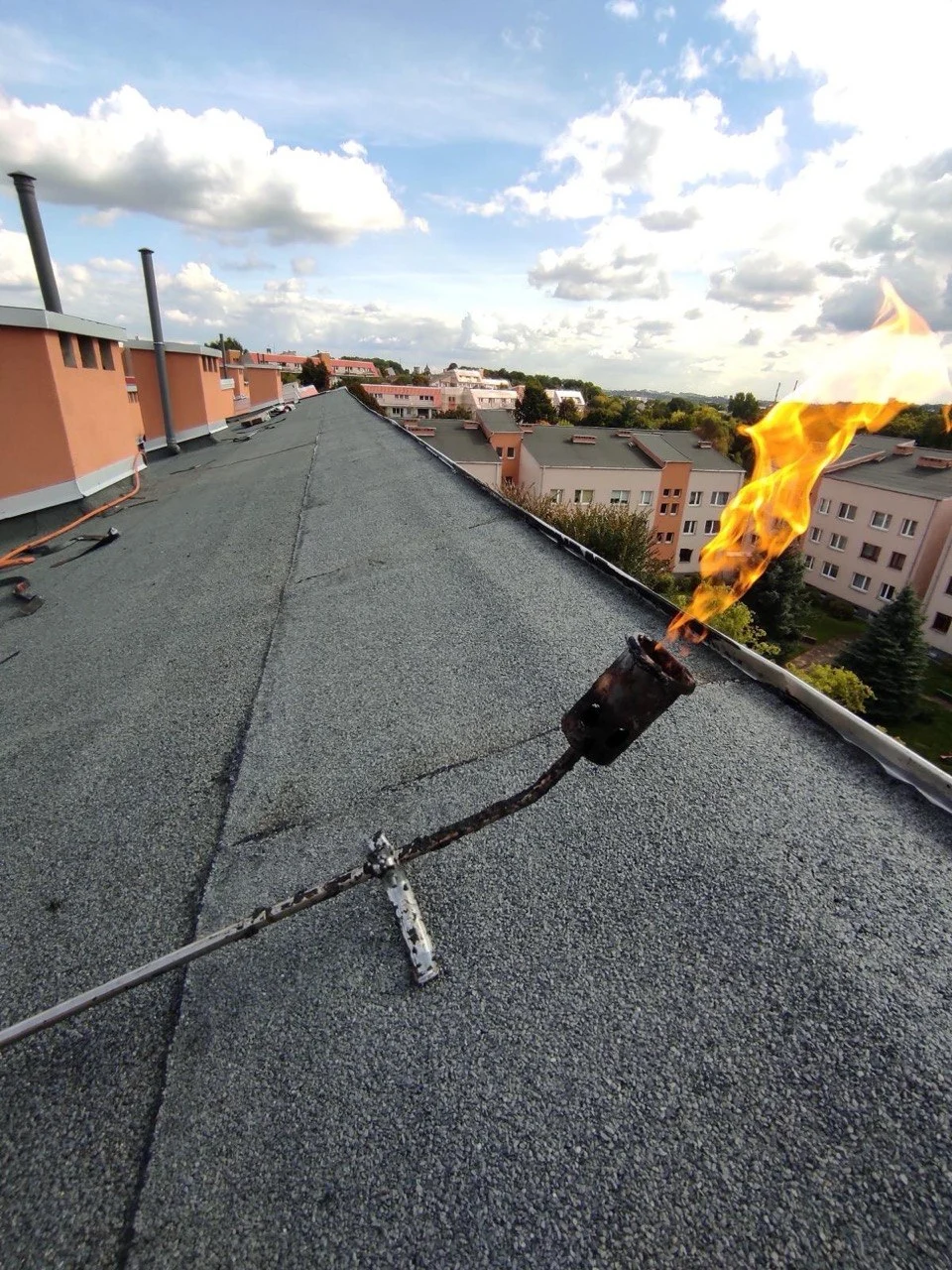
Torching the membrane — a controlled flame at the lap.The whole roof after completion: rooftop plant room, rooflight, ventilation chimneys and flashed parapet walls.Rooftop plant room — flashing at the wall, chimneys and service penetrations.A roof vent bonded into the covering; scaffolding by the parapet wall in the background.
Laying the first layer of bitumen membraneBase sheet
32–35zł/m²
Laying the second layer of bitumen membraneCap sheet
35–40zł/m²
Roof vent
70zł/pcs
Upstand flashings (parapet wall)Width over 60 cm
35zł/m²
Upstand flashingsWidth up to 60 cm
35zł/lin. m
Roof insulation with bitumen-faced EPS boards
Laying bitumen-faced EPS boards2–4 fixings per m²
35zł/m²
Fixing in the roof edge zoneIncreased number of mechanical fasteners: 6–9 per m²
Price to be agreed
Laying tapered EPS falls
25zł/m²
Laying EPS boards
25zł/m²
Laying the vapour control membrane
3–5zł/m²
Net prices for labour, materials extra; 23% VAT is added to the invoice. The contract includes a 10–15% contingency allowance for unforeseen work, e.g. repairing the substrate exposed after stripping the old bitumen roofing.
Questions
Do you also do the flashings?+
Yes, flashings at parapet walls, edges, outlets and penetrations are part of our work on flat roofs.
Bitumen-faced EPS or PIR?+
On bitumen-faced EPS boards, the membrane is torched straight onto the board surface. For the same thermal requirement, a PIR board is thinner, which matters with a low parapet wall. The choice depends on the roof — we decide during the site visit.
Can bitumen membrane be torched directly onto a PIR board?+
Yes, if the board has a glass-fleece or bitumen facing. With aluminium facing a different covering is used, e.g. a membrane. We choose the type of board to suit the planned technology.
What does the layer build-up depend on?+
On the substrate and what the roof is used for. As standard we use two layers of bitumen membrane — a base sheet and a cap sheet — torched separately, with staggered laps. We settle the exact build-up during the site visit.
Does the old bitumen roofing have to be stripped before the new one is laid?+
Not always. If the old bitumen roofing lies flat, with no blisters or signs of damp, a new layer can be laid over it. If it is damaged or the substrate is damp, we remove the old covering — we assess this during the site visit.
Is the work covered by a guarantee?+
We give a 5-year guarantee on completed work. The scope and terms are set out in our quotation, according to the chosen system and the scope of the job.
Quote
Describe the roof and attach photos — we’ll get back to you to arrange a site visit. We give an initial quote on site.